Posts

Showing posts with the label fibre optic network

EUNetwork's New Paris/Milano Route

Image
The well respected wide area network carrier has lit a new, shorter path connecting Milano and Paris data centers. While I believe you should never limit yourself to one vendor, EUNetworks is a very safe choice because it does the fundamentals well and is commercially flexible. The new route spans 1057 kilometers. EU did not provide a latency estimate, but it takes roughly 5.1 microseconds to traverse a kilometer. So multiply by 1057*2 and the RTD is approximately 10 ms. One diversity edge is that the route avoids Lyon. I recommend network planners consider to further diversity their network portfolio and reduce risk as a financail analysts might say. 

Amazon Deploying Hollow Core Fibre In Its 400G Backbone Long Haul Network

Image
Amazon's North American fibre optic network below. Its global network consists of nine million kilometers of owned fibre pairs. Amazon spent the last year experimenting with hollow core fibre and is now ready to join Microsoft in long haul deployments. See their blog for more setails:  https://aws.amazon.com/blogs/aws-insights/building-resilience-inside-awss-nine-million-kilometers-of-fiber-optic-cabling/. Microsoft has deployed hollow core fibre in the long haul to connect three AI data centres. It owns the leading hollow core manufacturer and research company, Lumenisity.  New hollow core designs unveiled in a recent Nature Photonics paper have solved the main obstacle to long haul deployment, namely high attenuation. High attenuation simply means light pulses fade rapidly and hence require frequent amplification. In contrast, Luminisity's new hollow core design unveiled in the Nature publication has 50% less attenuation than standard fibre. This means it can be incorpor...

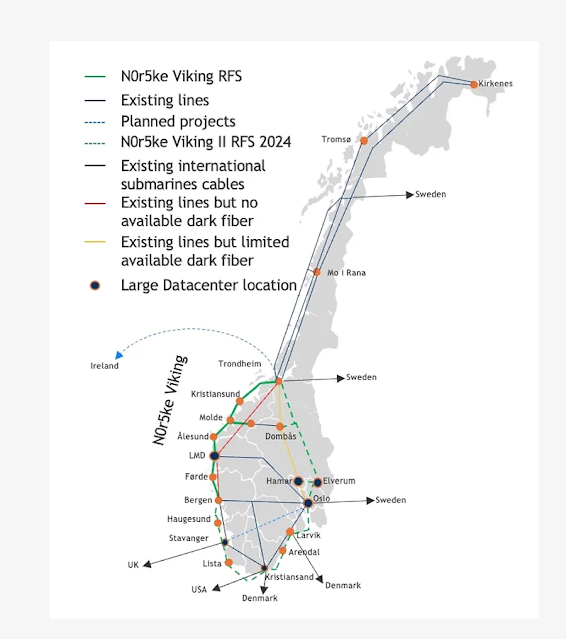
N0R5KE VIKING PROJECT

Image
This project is building a hybrid terrestrial-subsea network for Norway. The subsea portion is designed to link Norwegian cities on the West Coast. Building terrestrially between these cities is very expensive unless existing conduit is used. So the only cost effective approach to provide a route diverse to existing telecom rights of way is to go underwater. All Viking routes are 86 fibre pairs. The terrestrial routes connect not only the country's key telecom hotels, but also many of the major hyperscaler facilities as well as all of the cable landing stations. The Far North segment is for NATO and the Norwegian military. Norway shares a border with Mother Russia.  Viking's sales policy is to avoid the high overhead associated with lit services such as wavelengths. So only dark fibre will be leased or sold as IRUs. Dark fibre providers have very low operating costs. They can be run on a skelton crew. Fibre repair is always outsource to third parties. Simple devices can be inst...