Posts

Showing posts with the label switching costs

An AI Winter Is Coming: AI Data Center Stock Values Tanking - Part 1

Image
Stocks of publicly traded companies including Coreweave, META, Microsoft, and Oracle have lost 4% to 39% of their stock market value over the last year. Coreweave's core business is building data centers stocked with GPUs to rent AI service providers for estimation and inference. Obviously, this makes the standard data center look downright capital light. Racks must be populated with servers and GPUs and capable of handling 120Kw power loads. So power infrastructure and backup alone cost many multiples more on a per square meter basis than the standard telecom hotel. Moreover, these data centers must be bigger because a large language model might have trillions of parameters to be estimated. Coreweave's massive debt loads have led to a 37% decline in its market value over the last twelve months.  Secondly, customer switching costs are very low in the AI data center market. AI service providers are software companies. They download their data into the bare metal ...
Insights Into Equinix Financials and Operations

Image
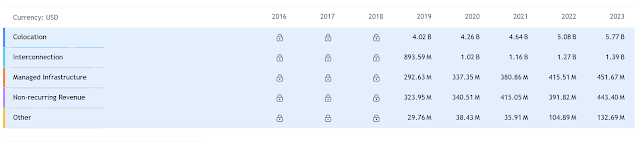
The beauty of publicly traded telecom infrastructure companies is that they cannot shroud their business in secrecy. Below is a very high level breakdown of Equinix revenues over the last several years. In 2023 the company got $1.9 billion from interconnection, which is its euphemism for cross connects. It comprised 19.4% of 2023 revenues. I must confess I am bit puzzled by how slowly the cross connect revenues are growing because Equinix offers no volume discounts (in Europe even big long haul carriers get only a few Euros off) to anybody. Moreover, Equinix is indispensable in many cities like Zurich, London (Slough, UK), and Amsterdam (AM5 is the best single peering point in the city). A 3Q2024 investor presentation says the company has 478,000 total interconnections. Let's assume each is a cross connect. That implies $3,974 USD per year or $331 per month, which seems too low. I invite readers to comment if they have an idea of what explains the discrepancy between the standard $...