Posts

Showing posts with the label Equiano

Notes On The African Subsea Telecom Market

Image
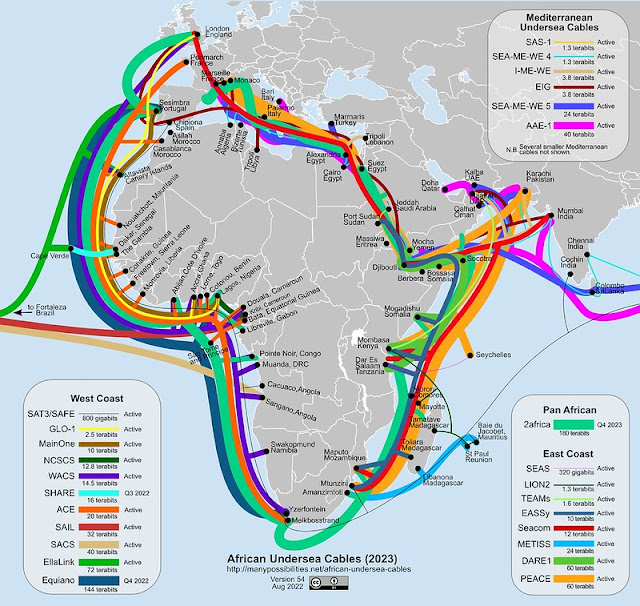
1. Capacity shortages will develop within 2 years because Equiano and 2Africa are insufficient given the vast number of countries they serve. Only South Africa and Nigeria have adequate capacity. But for many countries 2Africa is the only truly modern and reliable system with good long haul pricing and reasonable cross connect fees. Now 2Africa is 180 Tbps, but serves at least 30 countries in total. Even if we exclude the Pearls component, we are looking at Egypt, Italy, France, Portugal, UK, Sudan, Djibouti, Kenya, Somalia, Seychelles, Tanzania, Mozambique, Madagascar, South Africa, Angola, the two Congos, Gabon, Nigeria, Ivory Coast, Ghana, Senegal, Togo, and Senegal. I count 27 in the core African network. Divide by 180/27=6.7 Tbps. Capacity shortages are almost guaranteed particularly given some migration from the older, less reliable systems with their high cross connect charges to 2Africa and Equiano. One factor that may alleviate stress on the telecom...

African Subsea Cable Trends: Emerging Capacity Crunch & The Red Sea

Image
- 2Africa is much more expensive than Equiano. The 2Africa 100G pricing is $25K and above excluding tails for Lisbon to Lagos. In contrast, Equiano 100G pricing is below $20K now. Similarly, Equiano 10G pricing gravitates around $5K versus $10K on the same route for 2Africa.  The reason for this disparity is that the 144 Tbps Equiano cable primarily serves South Africa, Portugal, and Nigeria. In contrast, the 180 Tbps 2Africa network serves over 30 countries and Facebook kept 4 of the 16 pairs for itself. Note that the 2Africa map does not include the Pearls extension of 2Africa to the Persian Gulf, Pakistan, and Mumbai.  Another sign of the impending capacity crunch is the unwillingness of 2Africa consortium members to sell IRUs. An IRU is a long term capacity sale ranging typically dffrom 10 years to life of system. Carriers will not sell IRUs if they expect future capacity shortages or think they are likely. Many of these carriers have transit backbones that they must keep ...

Package Deal: 3x 100G Equiano Waves: $54K Total ($17K Per)

Image
 A point: Lisbon Equinix (LS1). Z point: MDXI, Server House or Medaillion facilities. Term: 1 Year. Cross connects not included.

African Subsea 10G & 100G Capacity Specials: WACS, 2Africa, & Equiano

Image
 2Africa; Senegal/Portugal; 100G; $18.5K; 2 Years. WACS; Ivory Coast/Portugal; 10G; $8,250; 3 Years. 2Africa; Nigeria/South Africa; 100G; $24,750; 1 Year. Equiano; Nigeria/South Africa; 100G; $20K; 1 Year. Equiano; Nigeria/Portugal; 100G; $19.5K; 2 Year. 2Africa; Ghana/Nigeria; 100G; $23.5K; 1 Year. 2Africa; Ivory Coast/Portugal; 10G; $10,500; 1 Year. 2Africa; Ivory Coast/Portugal; 100G; $33.5K; 3 Year. Remarks: 2Africa CLS cross connects are $150 max. WACS cross connect charges are five digit.

Great African Wavelength Deals: WACS & Equiano

Image
***5x 100Gs; CT1/LS1; Equiano The Stable Cable; $21K MRC Per Wave ***1x 100G; Johannesberg Teraco/London; WACS; $29.5K;Protected Back Haul; Photo credit: submarinenetworks.com

Lagos Subsea Cable Update

Image
With the exception of 2Africa, which has two landings one of which is 500 kilometers South of Lagos, all Nigerian landings are along a 25 kilometer wide beach in an area called Lekki. I expect 2Africa and Equiano to dominate the transport market going forward with 2Africa finally live in February or early March. At that point I expect combined capacity of these two modern cables to push prices into the teens for 100G waves. The older subsea cables like WACS, ACE, MainOne, SAT3, and GLO-1 will struggle to compete because their per bit costs are much higher. These older cables have far less capacity, but similar operating expenses similar to 2Africa or Equiano. For example, the older cables probably pay as much if not more for maintenance given their higher fault frequency. They are more likely to experience outages due to shallower burial and riskier routing through the blue ocean than either Equiano or 2Africa. Inferior service, higher costs. Not a recipe for success.  Unlike thei...

More Details On The Equiano Fibre Optic Subsea Cable

Image
Lisbon/Lagos is 77 ms RTD. My best estimate to date.  Shortest latency of all subsea cables between Lisbon and South Africa: 130 ms RTD. Also the most reliable and least expensive. Equiano lands not just in Portugal, Nigeria, and South Africa, but also Togo and Namibia. Any sufficiently large ISP in those four African countries should be on the system. Feel free to ping me for a quote. ☺ Deepest buried African subsea cable: averages 2 meters.

Equiano and 2Africa Updates

Image

Odds and Ends: Monday Update on Blue-Raman, 2Africa, and Equiano

Image
1. The last 2Africa splice should happen in December and the cable is likely to be fully live April, 2025. Not surprising given this is the most complicated submarine cable project ever undertaken with over 40 landings and many new cable landing stations. Right now only the Kenya to South Africa segment is live.  2. Blue-Raman is farther out than many Blue-Raman providers are willing to admit. Not 2nd quarter next year. But year's end for the all-important Marseille/Mumbai segment. Don't be fooled. Salesmen are Liars. 😀 Except for me, of course. 😊 3. I can sell you 5x 100Gs on any of the three Equiano segments today and three months down the road will have 25x 100Gs available on the Equiano cable. Plus I have affordable local loops from Lagos OADC to the other two key Lagos data centers. Moreover, the metro fibre is amplified which is important for ensuring acceptable 400G and 800G wave performance. Most Lagos 

Equiano: The West African ISP Buyer's Guide

Equiano is a Google cable. A 12 fibre pair spatial division multiplexing system designed to do at least 12 Tbps per pair. This cable is a must-have for African ISPs as it connects the three key telecom hubs of Portugal (Lisbon Equinix (LS1)), Nigeria (the Open Access Data Center (OADC) in Lagos), and South Africa (Capetown Teraco (CT1) in South Africa), has massive capacity and is vastly more reliable than older African cables.  Equiano not only connects the key telecom hubs essential to West Africa's Internet, but is also buried two meters deep and avoids the dangerous undersea areas like the Congo canyon and Le Trou Sans Fin that have caused many subsea outages. Le Trou experienced a debris slide this Spring that caused 4 African cables (SAT3, Mainone, WACS, and ACE) to be severed in the Ivory Coast's territorial waters. Equiano saved West Africa's Internet from a complete subsequent meltdown as its capacity was used to reroute traffic to Lisbon or South Africa. Equiano...

Transmission Co, Lagos Metro Wavelengths, & Equiano Subsea Capacity

Image
Transmission Co is a new Lagos metro network with fibre between the three key data centers of OADC, Rack Centre, and MDXI Equinix. It is currently expanding into another three sites. This network is amplified in order to ensure high performance for 400G and 800G wavelengths. We can offer you metro wavelengths between these three data on-net facilities configured as a ring at excellent pricing with significant term and volume discounts. Also available are spectrum and alien waves. Mark Tinka, former head of Seacom engineering, is the founder and CEO. I work directly with him on sales opportunities. Mark is well known and respected in the Internet engineering community. We can be reached at roderick.beck@networksourcing.net.  The best way to think about spectrum is that it is a virtual fibre pair. If you take 100 Gigahertz on the network, then you feed it into your DWDM gear and carve it up and frame as OTN circuits. In this case you can get a 400G wavelength or several 100G waves i...